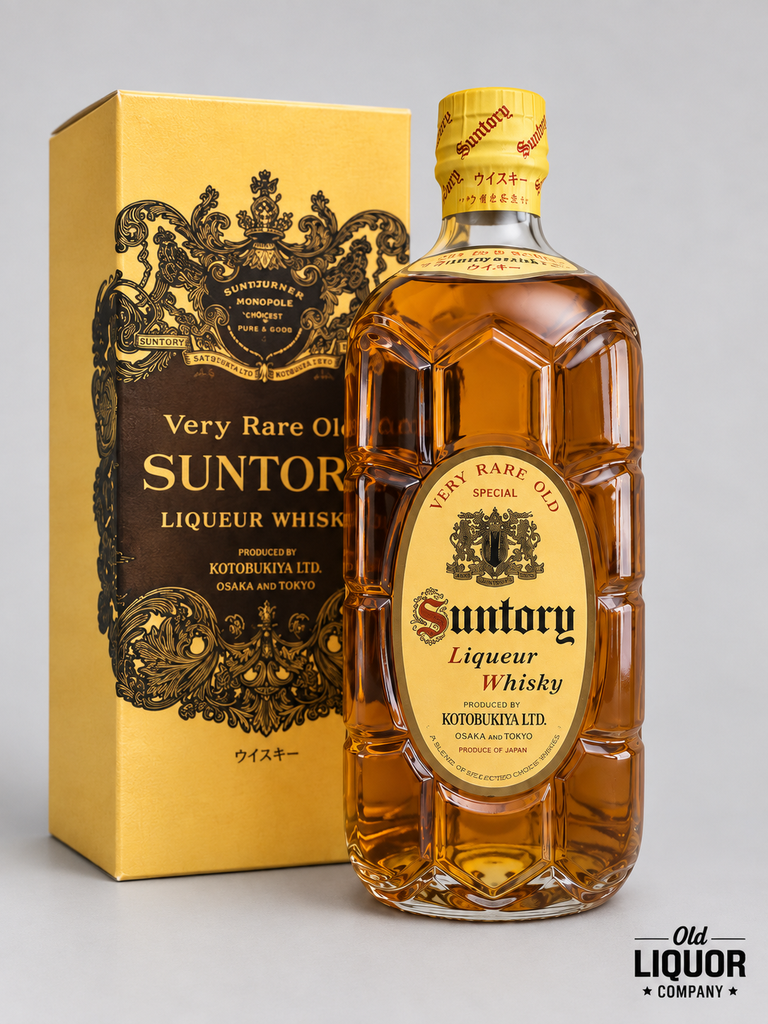
The story of Suntory is effectively the story of Japanese whisky itself. What started as a modest storefront in Osaka evolved into a sprawling global beverage empire, propelled by a distinct corporate philosophy: "Yatte Minahare"—the courage to dream big and venture into the unknown.
🍇 1899–1907: The Wine Shop Roots
In February 1899, a young entrepreneur named Shinjiro Torii opened a small shop in Osaka called Torii Shoten, specializing in imported Western wines. However, the traditional Japanese palate found imported European wines too dry and acidic.
Refusing to accept failure, Torii spent years blending, sweetening, and adapting recipes until 1907, when he launched Akadama Port Wine (now Akadama Sweet Wine). It was a massive success, establishing the financial backbone of the company and cementing Torii’s status as a master blender.
🥃 1923–1929: The Birth of Japanese Whisky
Torii’s ultimate dream was to create a genuine, world-class whisky entirely crafted in Japan. In 1921, he renamed his growing company Kotobukiya Ltd., and in 1923, he broke ground on the Yamazaki Distilleryon the outskirts of Kyoto—a location chosen for its legendary, pristine water quality and misty climate.
To manage the distillery, Torii hired Masataka Taketsuru, a brilliant young man who had traveled to Scotland to study organic chemistry and apprentice at traditional Speyside distilleries.
- The Historical Spark (1929): Together, they released Japan's first domestically produced whisky: Suntory Shirofuda (White Label). It was marketed as a "Rare Old Island Whisky" to pay homage to the Scotch tradition.
- The Initial Failure: Shirofuda was heavily peated and smoky. The Japanese market, unaccustomed to such a heavy profile, rejected it. Taketsuru would eventually part ways with Torii to build his own distillery in Hokkaido (which became Nikka Whisky).
🐢 1937–1950: Tuning the National Palate
Torii realized that to succeed, he had to craft a spirit suited to the subtle, delicate preferences of Japanese cuisine and culture.
- 1937 (The Kakubin Breakthrough): Suntory launched Kakubin (Square Bottle). Balanced, slightly sweet, and exceptionally clean, Kakubin became an instant cultural icon and remains Japan's best-selling whisky to this day.
- 1950 (Suntory Old): Following the hardships of World War II, the house introduced Suntory Old. Affectionately nicknamed "Daruma" due to its squat, round black shape, it became the gold standard of premium corporate gifting in post-war Japan.
🌐 1963–Present: Global Imperial Expansion
In 1963, the firm permanently changed its name from Kotobukiya to Suntory Limited, taking the name from the "Sun" in Akadama and the founder's surname ("Torii-san" → San-Torii). Shinjiro's son, Keizo Saji, took over as the second president and continued to expand the brand's creative boundaries.