The history of Karuizawa is one of the most fascinating "ghost distillery" stories in the spirits world. What started as an uncompromising attempt to make traditional Scottish malt in Japan eventually transformed into the ultimate collector's holy grail.
1. The Early Beginnings (1955–1959)
The distillery was established in 1955 by the wine and spirits company Daikoku Budoshu (which later became part of the Mercian Corporation). It was built in Miyota, a town located on the picturesque, snow-capped slopes of Mount Asama, an active volcano.
The climate here was highly unique for aging: the high altitude brought freezing alpine winters and hot summers. This severe temperature fluctuation caused intense interactions between the wood and the liquid, resulting in a dark, robust, and heavily structured spirit.
2. The Uncompromising Scotch Tradition
From the first liquid flowing off the stills in 1956, the goal was to strictly replicate the heavy, rich profile of traditional Scotch—specifically aiming for a style similar to The Macallan. To achieve this, the team operated under strict rules:
- The Barley: When import rules lifted in 1958, they strictly imported Golden Promise barley malt from Scotland, a premium variety renowned for deep, oilier flavors.
- The Stills: They utilized four unusually small, traditional copper pot stills.
- The Wood: The vast majority of the spirit was matured almost exclusively in high-quality Spanish Oak Sherry Butts.
3. The Forgotten Blended Era (1960–1999)
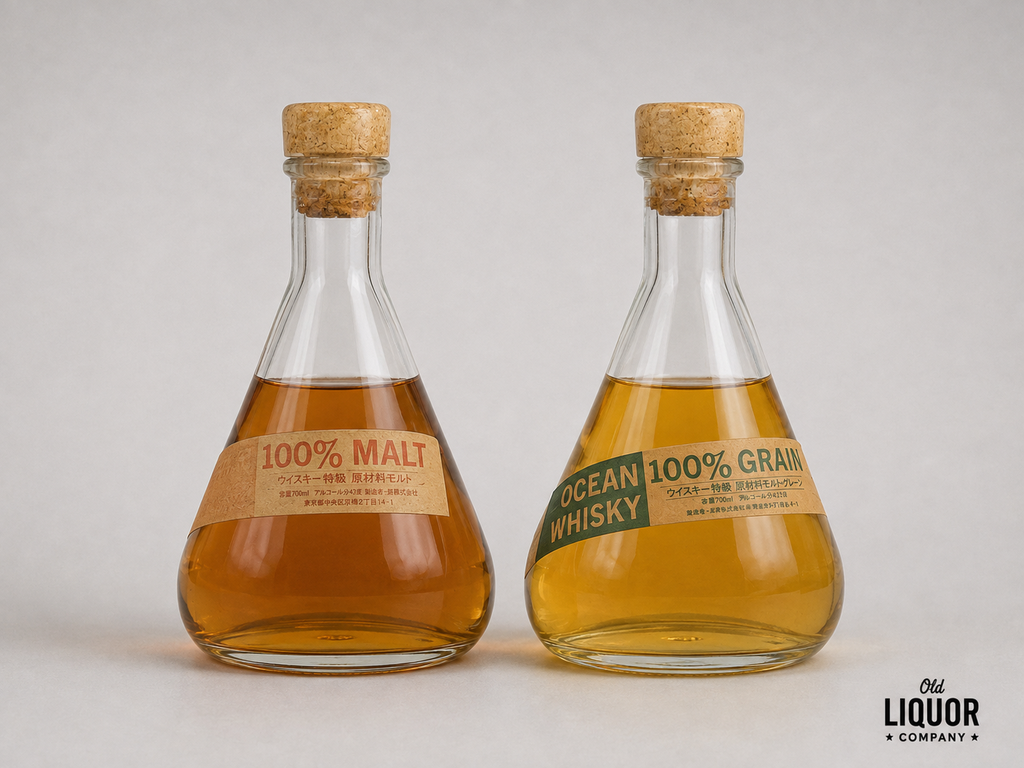
For most of its operating life, Karuizawa was not celebrated as a standalone malt. Following the Scottish model, the distillery's bold, unpeated, and lightly peated spirits were treated as the "heart" or building block to elevate domestic Japanese blended whiskies, sold under the label Ocean Whisky.
It wasn't until 1976 that the distillery finally released its very first official single malt bottle. Unfortunately, during the late 1980s and 1990s, Japan hit a massive economic recession. Simultaneously, local consumer preferences shifted drastically away from dark spirits toward light highballs and beer, while tax reforms favored imported Scotch. Domestic production plummeted across the entire country.
4. The Silent Collapse (2000–2011)
Unable to stay financially viable, production ceased and the distillery was officially mothballed on December 31, 2000
In 2006, the beer giant Kirin acquired Mercian Corporation, primarily inheriting their profitable wine operations. Kirin had no strategic interest in reviving the tiny, mothballed whisky distillery. By 2011, the site was closed permanently, and the land was eventually sold to a property developer. The original copper stills and remaining hardware were auctioned off and now sit at the Shizuoka Distillery. The original buildings were completely demolished in 2016.
5. Rise of a "Ghost Legend" (2006–Present)
The global phenomenon of Karuizawa happened almost completely after it died. Around 2006, an independent group called the Number One Drinks Company (led by Marcin Miller and David Croll) recognized the staggering quality of the remaining liquid. They struck a deal to purchase all the remaining inventory—only about 300 pristine casks.
As they slowly released these casks as ultra-limited, single-cask bottlings (often dressed with artistic labels like Geishas, Noh Masks, and Dragons), the international whisky boom erupted. Connoisseurs suddenly realized that Karuizawa offered a deeply complex, old-school sherry profile that modern distilleries could no longer replicate.
Because the distillery was demolished, the remaining supply was strictly finite. Bottles that originally sold for less than £100 rapidly skyrocketed to thousands, and then tens of thousands at international auction houses like Sotheby's and Christie's. Today, it is regarded alongside legendary names like Brora and Port Ellen as one of the ultimate "lost icons" of whisky history.