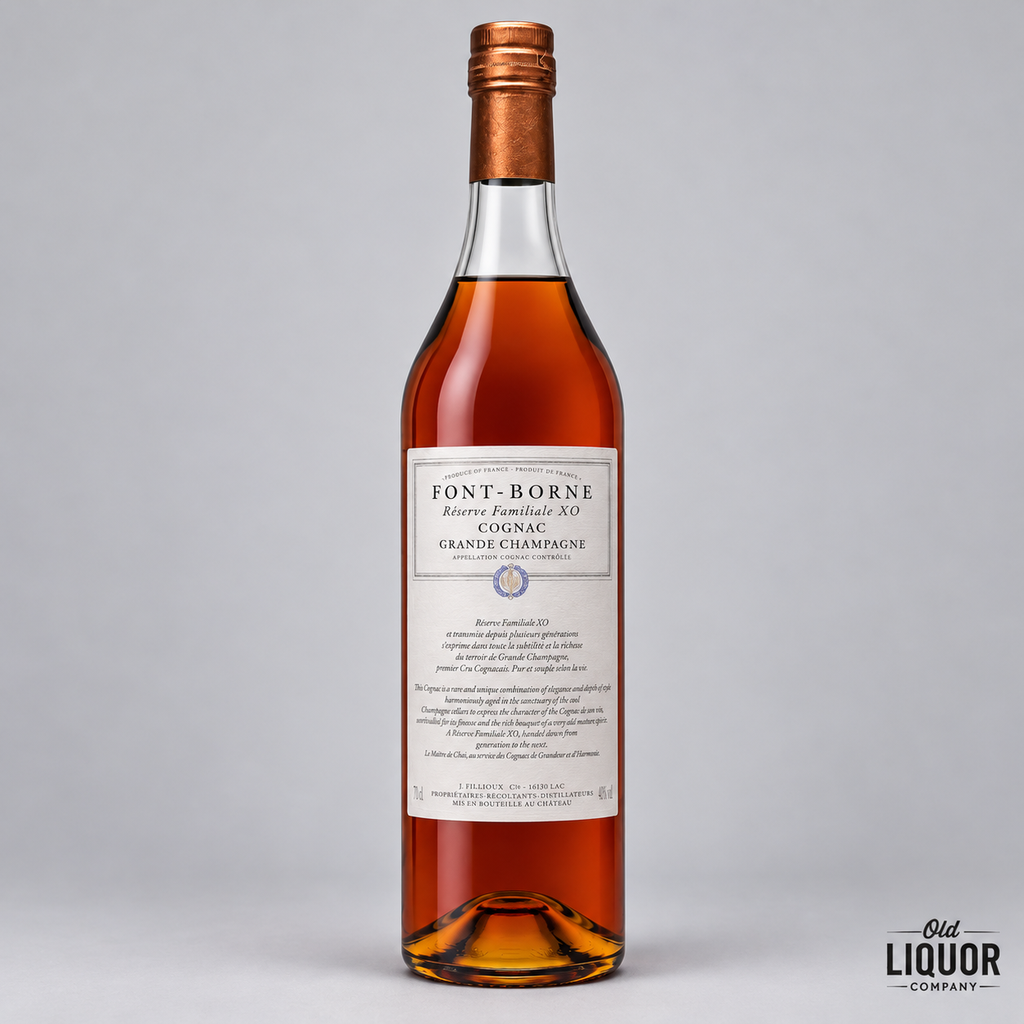
The history of the Jobit (Font-Borne) cognac house tells the story of a respected, artisanal family estate deeply rooted in the Charente region throughout the 19th and 20th centuries. Today, it is highly regarded as a legendary "ghost" cognac house because its original estate production ceased entirely around the turn of the millennium.
The family heritage is split into two distinct branches, each leaving a lasting mark on the spirits industry of southwest France:
1. The Main Origin: Font-Borne in Malaville
The specific brand featured on your bottle, Font-Borne, was established in 1850 by the Jobit family in Malaville. This village sits in the absolute heart of the Grande Champagne region, widely recognized as the premier cru of the Cognac area.
- The Golden Years: Font-Borne operated as a small-scale, traditional producer (bouilleur de cru) with a modest vineyard estate spanning roughly 12 hectares. Because production was highly limited, the family rarely exported their stock. Instead, they supplied exclusive French establishments directly, including the legendary three-star restaurant Taillevent in Paris, as well as prominent local venues like Le Chanzy in Barbezieux.
- The End of an Era: The distillery was passed down through multiple generations. In the late 20th century, it was managed by family patriarchs George Jobit and Vivian Jobit. Lacking younger family successors willing to continue the rigorous manual labor of traditional distilling, production stopped entirely around the year 2000. The vineyards were sold, and the final remaining barrels from the family's oldest private stock (Héritage) were bottled and released in 2016.
2. The Merchant Branch: Ch. Jobit & Cie (Cognac Town)
Parallel to the small agricultural estate in the Grande Champagne countryside, a separate commercial merchant branch of the family operated under the name Ch. Jobit & Cie.
- This trading house (maison de négoce) was founded much earlier, in 1833, in the historic center of the town of Cognac (located on Rue de la Poudrière).
- They constructed vast aging cellars starting in 1860 and added their own distillery in 1911. This merchant arm eventually shut down operations in 1955, after which the brand name "Jobit" was sold to larger wine merchants like Calvet and eventually passed to Cognac Larsen.
3. The Modern Era: Domaine Montansier
The family's deep connection to viticulture survived through a separate branch of the Jobit lineage. For seven generations, this line of the family has grown grapes in the nearby village of Graves-Saint-Amant. Today, this winemaking tradition is alive under the name Maison Jobit / Domaine Montansier. They manage 35 hectares of vineyards spanning both the Grande and Petite Champagne regions, producing artisanal cognacs, Pineau des Charentes, and regional wines.