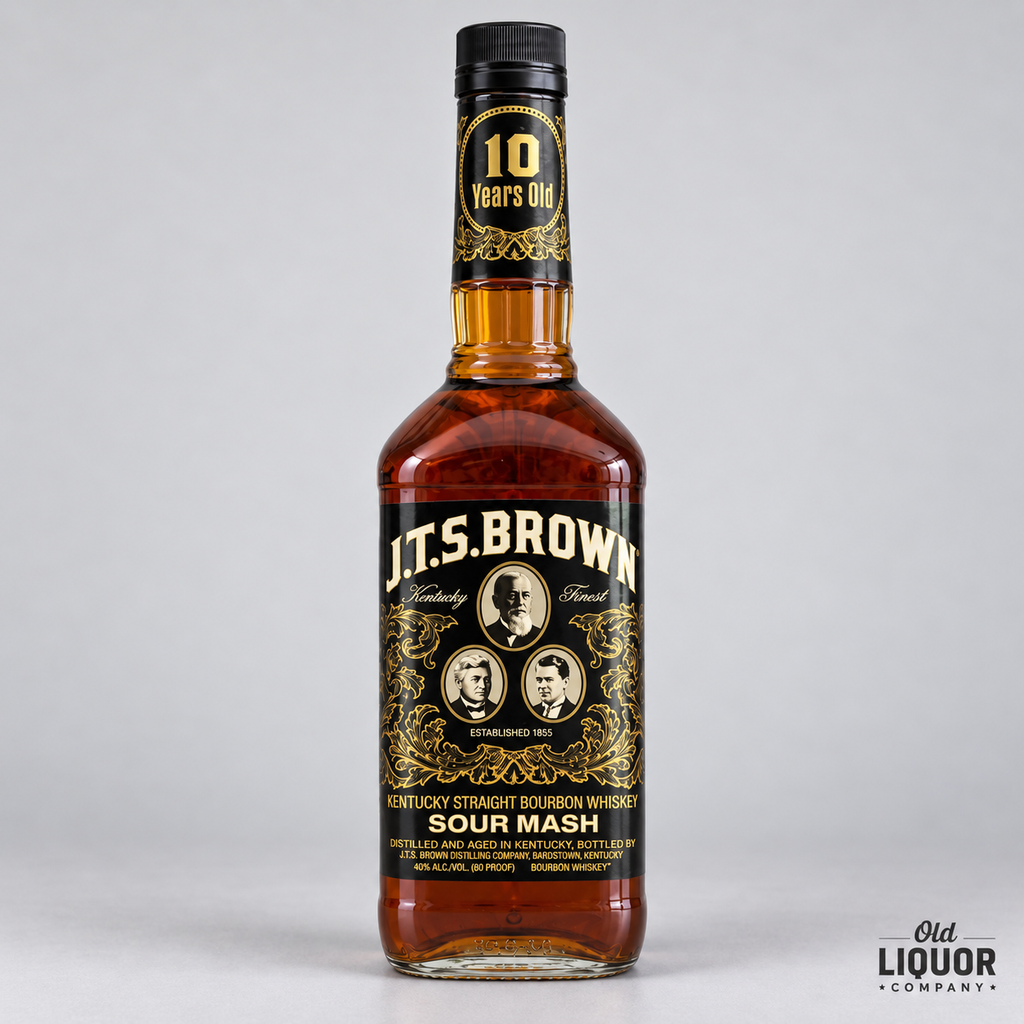
J.T.S. Brown is one of the oldest and most historically significant names in the American whiskey industry. While it is widely recognized today as a budget-friendly "table bourbon" produced by Heaven Hill, its origins are deeply tied to the creation of the massive spirits empire known as Brown-Forman.
The history of J.T.S. Brown unfolds across four key chapters:
1. The Tale of Two Half-Brothers (1870)
The brand is named after John Thompson Street Brown Sr. (born in 1826). In 1870, J.T.S. Brown and his younger half-brother, George Garvin Brown, opened a wholesale liquor business on Louisville’s famous "Whiskey Row" on Main Street, operating under the name J.T.S. Brown & Brother.
They made industry history by becoming the first company to sell whiskey exclusively in sealed glass bottles to guarantee quality and prevent rectifiers from watering down or adulterating the spirits. However, the partnership was short-lived. By 1874, a rift formed between the siblings:
- George wanted to focus strictly on higher-end, premium medicinal-grade whiskeys (which led him to create Old Forester and grow the business into the modern Brown-Forman corporation).
- J.T.S. wanted to focus on mass-appeal, high-volume spirits.
2. Building an Architectural Icon
After parting ways with his brother, J.T.S. Brown struck out on his own and eventually formed J.T.S. Brown & Sons alongside his progeny.
The family expanded into distilling, and in 1910, they built the historic Old Prentice Distillery in Lawrenceburg, Kentucky. This distillery is highly famous today for its unique Spanish Mission-style architecture and operates as the home of Four Roses Bourbon.
3. Corporate Shifts and the Move to Heaven Hill
Following Prohibition, the brand briefly returned under the leadership of J.T.S. Brown's grandson, Creel Brown Jr.. However, the landscape of American whiskey was rapidly consolidating.
During World War II, the distillery and the brand were sold to the Canadian conglomerate Seagrams. In the mid-1950s, the brand transitioned again, eventually being acquired by Heaven Hill Distillery. Heaven Hill integrated the historical label into its portfolio, distilling it at their plant in Bardstown, Kentucky, until the catastrophic distillery fire of 1996.
4. Pop Culture and Modern "Bottom Shelf" Royalty
In the modern era, J.T.S. Brown achieved legendary pop culture status through the 1961 classic film The Hustler. Fast Eddie Felson (played by Paul Newman) famously orders "J.T.S. Brown, no ice, no glass" while playing pool, cementing the bourbon's reputation as a no-nonsense, hard-nosed working man's drink.
Today, Heaven Hill produces J.T.S. Brown at the Bernheim Distillery in Louisville. It is sold primarily in two value-tier expressions:
- An 80-proof (40% ABV) standard release.
- A highly respected 100-proof Bottled-in-Bond expression.
Because it shares the exact same high-rye mash bill (78% corn, 10% rye, 12% malted barley) and aging warehouses as premium brands like Evan Williams and Elijah Craig, it is widely celebrated by whiskey enthusiasts as one of the single best budget bourbons on the market.